

MNP in Netherlands
Mobile Number portability in the Netherlands is a flexible and customer-friendly process that can be performed any day of the week and at any time of the day, with no predefined cutover windows. The process is recipient-led, meaning the new operator takes responsibility for initiating and managing the port.
For both prepaid and postpaid customers, the only information needed is the porting number itself. The earliest possible date for porting is determined by the donor operator, and it can be immediate, allowing the number to be transferred as soon as the request is made. The latest possible date is up to 120 days from the first possible date.
The recipient operator can cancel a port if necessary, and while ports can be rescheduled internally, there is no formal rescheduling between operators. Customers can also request portability up to 30 days after terminating their contract, and there are no locked periods that prevent cancellation or porting.
MNP Lifecycles
MNP-IN
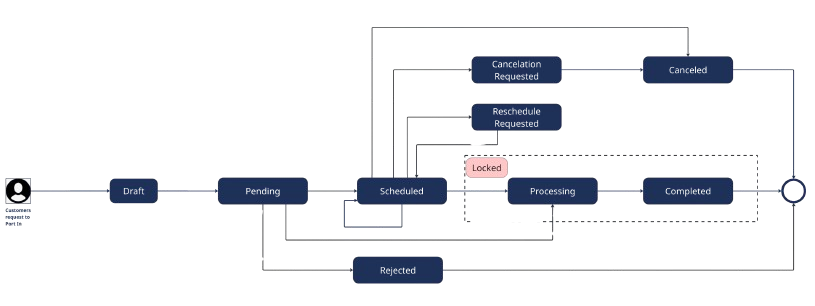
Porting Lifecycle
Draft : The porting request is initially created in this status. All required information can be added or updated before the request is submitted for further processing.
Pending : The request moves to Pending once validations are completed. At this stage, the request is sent to the donor service provider for acceptance.
Scheduled : The request enters the Scheduled status once it is accepted by the other service provider and a porting date/time is scheduled. The scheduled date represents when the actual porting activity is planned to occur.
While in this status, cancellation requests and reschedule requests can be raised. All cancellation and reschedule requests must comply with the defined deadline rules.
Processing : The request moves to Processing when the scheduled porting date/time is reached. In some cases, the request may transition directly from Pending to Processing if the schedule date is immediate or “now.” Active provisioning and technical porting activities are executed during this phase, and changes, cancellations, or reschedules are no longer allowed once Processing has started.
Completed : The porting request is marked as Completed after successful provisioning.
Cancelation Requested : In Port-In, the customer may decide to cancel the request while it is in the Scheduled state. This option must be available on both the Donor’s and the Recipient’s end. The cancellation request will be either approved or rejected. If approved, the porting request will be cancelled. If rejected, the request will transition back to the previous status, i.e., Scheduled.
Reschedule Requested : In case of rescheduling, the Recipient proposes a new porting date, and the request transitions back to Scheduled with the new date. If the reschedule request is rejected, the porting request transitions back to Scheduled with the original date.
Rejected : If validation fails or the donor service provider rejects the request while in Pending status, the porting request transitions to Rejected.
MNP-OUT
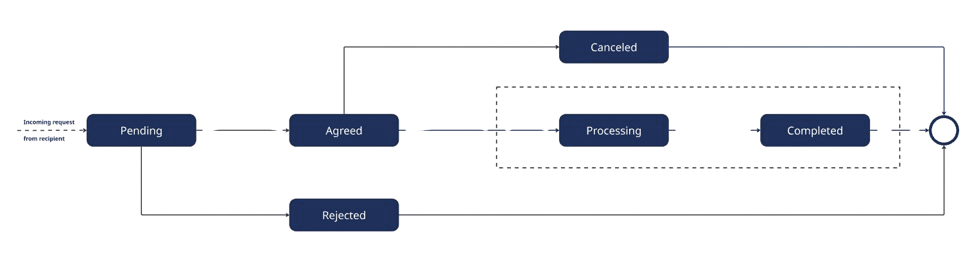
Porting Lifecycle
Pending : The MNP-Out (Port-Out) process begins when the donor receives the Port-Out request from the regulator in the Pending state. During this state 1GLOBAL will perform typical validations and requests from the partner to accept or reject (typically, the partner shall accept by default for prepaid cases). If all validations pass, the request will transition to a Agreed state or become Rejected due to a data mismatch.
Agreed : Request was accepted and is waiting for the recipient service operator to start the portability process. Recipient service operator can cancel the request at any time AND the request will be Canceled status.
Processing : The recipient service operator will start the portability process on the agreed date.
Completed : The porting request is marked as Completed after successful de-provisioning.
Canceled : The portability request was canceled by the recipient service operator.
Rejected : If validation fails, porting request transitions to Rejected status.
Rejection Reasons
During the Mobile Number Portability (MNP-NL) process, a porting request may be rejected if certain validations fail or if specific business rules are not met. Each rejection is associated with a reason and a descriptive message (if available), which helps partners understand the reason for the rejection and take corrective action if applicable.
The rejection reasons are summarized in the table below:
| Rejection Reason | Description |
|---|---|
| msisdn_customer_mismatch | The provided MSISDN does not match with the provided customer under the provided account number |
| msisdn_not_portable | The provided msisdn can’t be ported-out |
| msisdn_name_address_mismatch | The provided MSISDN does not match with the provided name or address |
| no_porting_window | No porting happening in the timeframe |
| porting_already_in_progress | The provided MSISDN is already involve in an in progress portability |
| other | If there is no clear reason, it will be mark as other |
Required Customer Data
Personal Account
- First Name
- Last Name
- Address
- Account Number
Business Account
- Company Name
- Business Address
- Billing Address ( if different from Business Address)
- Account Number
API endpoints
Endpoints were added as Mandatory and Optional. The reasoning for this clustering is explained as follows:
- Mandatory means they are part of the MNP core process and without them, it is not possible to go through the process from the start until the end.
- Optional means they are available to be considered by the Partner to enable specific business, customer service processes supporting the MNP process.
| Endpoint | Required |
|---|---|
| Get phone-number-id from subscription | Mandatory |
| Create a new port order (Port-In) | Mandatory |
| Request cancelation of the Porting | Mandatory |
| Request reschedule of the Porting | Mandatory |
| List all Porting requests | Optional |
| Get a specific Porting | Optional |
| Patch a Porting processing action | Optional |