

SIM Profile
A SIM Profile represents a SIM managed by 1GLOBAL. The sim_type field identifies whether it is a physical SIM (pSIM) or an eSIM:
- pSIM — a physical SIM card. Your integration reserves and activates it through an activation code.
- eSIM — a downloadable profile provisioned as part of an activation order. No separate activation code is required.
Common fields on every SIM Profile:
- an
id(prefixsimp_) and aniccid— the identifiers of the SIM - a
sim_type(psimoresim) - a lifecycle
status
The rest of this page focuses on pSIM specifics: activation code, reservation lifecycle, and PIN/PUK codes. For eSIM delivery and installation, see Install an eSIM.
Activation code
The activation code is what the end customer uses to bring a physical SIM online. It is generated by Connect during provisioning, bound one-to-one to the SIM's ICCID, and printed onto the final SIM card packaging shipped to the partner.
The exact format of the activation code is configured per partner. Refer to your onboarding contact for the format used in your tenant.
Lifecycle
The lifecycle below applies to pSIM Profiles.
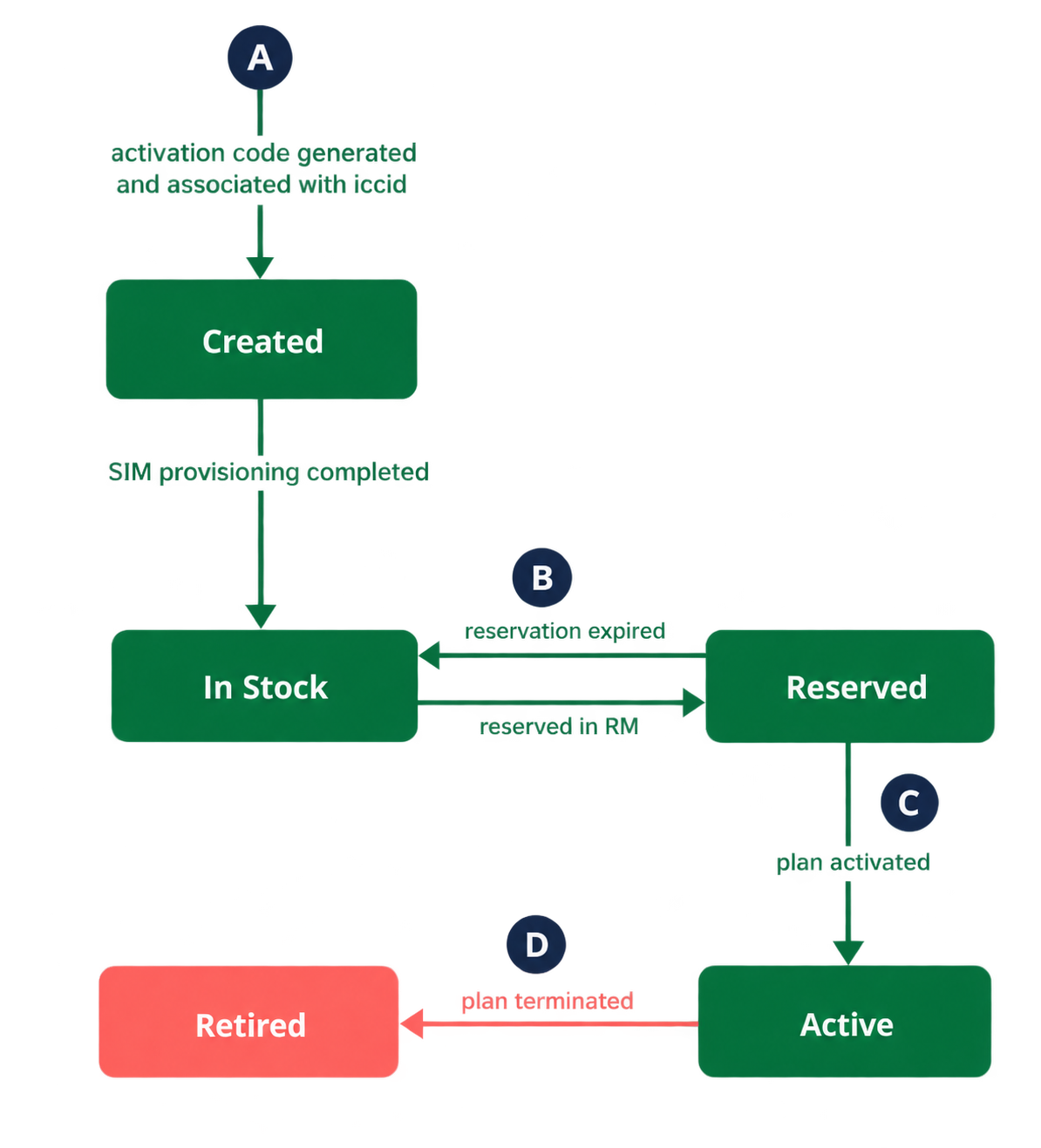
The status field tracks where the SIM sits in its lifecycle:
- Created — an activation code has been generated and bound to the ICCID, but the SIM has not yet been placed in inventory.
- In Stock — SIM provisioning has completed and the profile is available to be reserved.
- Reserved — the SIM Profile has been reserved against a Subscription using its activation code. Reservations have a configurable expiration (
PSIM_RESERVATION_DURATION, set per tenant/partner). If the plan is not activated before it expires, the profile returns to In Stock. - Active — the plan tied to the SIM Profile has been activated; the SIM is in use.
- Retired — the plan has been terminated and the profile is no longer usable.
Valid transitions:
- Created → In Stock
- In Stock → Reserved (on reservation)
- Reserved → In Stock (on reservation expiry)
- Reserved → Active (on plan activation)
- Active → Retired (on plan termination)
Lifecycle transitions are emitted as webhook events under the subscription.sim_profile.* family — see Go to Production for the critical events your integration should handle.
PIN and PUK codes
Every pSIM Profile has PIN and PUK secret codes required by the end user to unlock the physical card. These codes are exposed through a dedicated endpoint so your integration can display them to the end customer through your own secure channel.
Do not log, cache, or otherwise persist these values outside of a secured surface. Treat them the same way you would treat any other end-user secret.
API Reference
See the full list of endpoints, request and response schemas, examples, and version information in the SIM Profiles section of the API Reference.